Monday, May 15, 2017

My AMSAT Etiquette - Rule 2


Rule 2: I let the DX have the bird

The Things you find Google Image Searching a Term
When operating, if I hear a rare station, a rover, a portable operator, or anything that is generally uncommon, I will typically let them have the bird and make as many contacts as they can. This is generally the same idea behind letting a DX keep an HF frequency, except on the Satellite there is a finite amount of time they will be able to make contacts, and it's important to give them as much time as possible. Even more so, since FM repeater birds typically are considered 'easier' to work, and require less equipment for the operator, these are more commonly used by rovers or portable operators who may not be full time AMSAT ops, or may have only a small amount of gear to work with. 

In the SOTA world we have a saying - 'The Activator is King' - I think that applies in the Satellite world too.. the DX is king. If someone is somewhere rare, I can wait for another pass to say hi to theguy a few grids away who I hear all the time - ESPECIALLY if I'm on a single channel FM bird. If I'm on a linear bird, and I just *have* to ragchew with someone, I'll spin my dial way off of center, reduce my power to minimum (to make sure the DX has as much of the transponder's power as they can) and then talk to my buddy there.

When I try to think of an exception or a caveat to this rule, and I'm coming up blank. What do you think? Any exceptions or reasons you shouldn't let a rare DX have the bird? 

Monday, May 8, 2017

CM93 Part 3: The Channel Islands National Park

This is the final piece on the trip to Santa Rosa, and CM93. And It's going to be a bit different from other things you read on this site. Yes, the trip was primarily done to activate the rare grid of CM93, but with the National Parks on the Air celebration of 2016 - the plan was rushed to make sure it would happen for the event, instead of waiting until another year. The Channel Islands are unlike any other place I've been in the lower 48 states... Walking around on Santa Rosa reminded me of South Texas, Wyoming, and the Washington Coast, all at one time, and all in the course of a few miles. Our National Parks are a treasure that we're lucky to have as Americans, and this entry will talk about what we saw when we packed our radios away.

The Channel Islands are actually a newer addition to the National Park System. For many years they were owned by Cattle Ranchers who used them as a fence-less open range area, for grazing purposes. They would bring over young herds on barges, let them forage on the Island for a while getting fat, then take them back to the mainland for sale. While an interesting use of the land, there was so much more than could have been done with them. Eventually thru the trials of time the Islands found their way into the hands of the National Park Service, who have developed them into a wilderness only miles away from one of the most densely populated areas of the country in Southern California.

On our trip, Friday and Saturday was about operating. Yes, we climbed Black Mountain, and explored the interior a bit, but our focus was on making QSOs. Sunday morning we changed gears. We secured our camp very early in the morning, locked up the radios, dropped off our heavy packs at the dock, and headed towards 'Lobo Canyon' on the north central part of the Island.


I took this picture on our hike to the Canyon as the Sun came out. It reminded me very much of the high plains country of West Texas or Wyoming.


The hike to Lobo paid off quickly, as we spotted one of the rare Island Foxes native to Santa Rosa, but rarely are seen by visitors near the campground or dock.


Shortly after the fox sighting, we can to the first of what I can only describe as a 'Badlands' or a 'Scarp' region. Since the majority of the island is a raised rounded dome, where water would flow towards the ocean, these little canyons would form - leaving behind some stunning rock and dirt formations. 


A little ways after the Scarp formation, we began the descent into the Canyon. A long switchback along the Canyon wall slowly dropped us 500' in elevation, and we entered Lobo. 


We stopped for a selfie at the sign marking the beginning of the Lobo Canyon Trail. At this point is was 1030AM and we have already hiked something like 8 miles. 


The Canyon started as a more arid environment, but as we progressed we started finding greenery and water. 


Amongst the green and slowly descending elevation were multiple rock overhangs and cave dwellings that would have served well as shelter to earlier peoples. 


As we kept walking, I got the GoPro out, and took some footage. I've finally finished processing all this footage, and present it to you here:


After exploring the confluence of the Canyon and the Ocean, we started back for the Dock. Our boat was picking us up at 1500 sharp, and we had a flight home the next morning. After getting on the boat, scoring some pizza and beer, we relaxed for the ride home. About halfway back, while along the coast of Santa Cruz Island, the Captain said something about 'The Painted Cave'. Since this obviously sounded awesome, we both ran to the front of the boat and saw what was referred to as the 'Largest Sea Cave in the World, by people who record these sorts of things"


And of course, took some quick video with the phone


Seeing the cave was really cool, and a fitting end to the journey. The combination of rock and water, was really what shaped and made the Channel Islands what they are. It's interesting to think of the combinations of very unique factors that led me to this place. I suppose that's what its all about though - taking advantages of the opportunities when they arise, and then making the most of the moment. I did that in the Channel Islands, and I hope to come back some day. 

Monday, May 1, 2017

Tips from the Field - Grid Mapping Tools

One of the emails I had a while back from a reader was asking for information about roving, from the perspective of how do you know where you are in a grid. It occurred to me, that putting together a comprehensive list of Grid and Mapping tools would be a worthy Tech Blog Entry. So here we go.


QTH Locator by F6FVY


I love this tool. You open a webpage. Punch in the grid you want (In either 2, 4, or 6 character sizes) and it draws a box around your requested area in Google Maps. You can toggle among standard road map, terrain, and Satellite images. When planning a road trip to random places, I will spend hours sometimes using this tool to make sure I hit the grids I'm after. It's a true thing of beauty. Check it out Here.

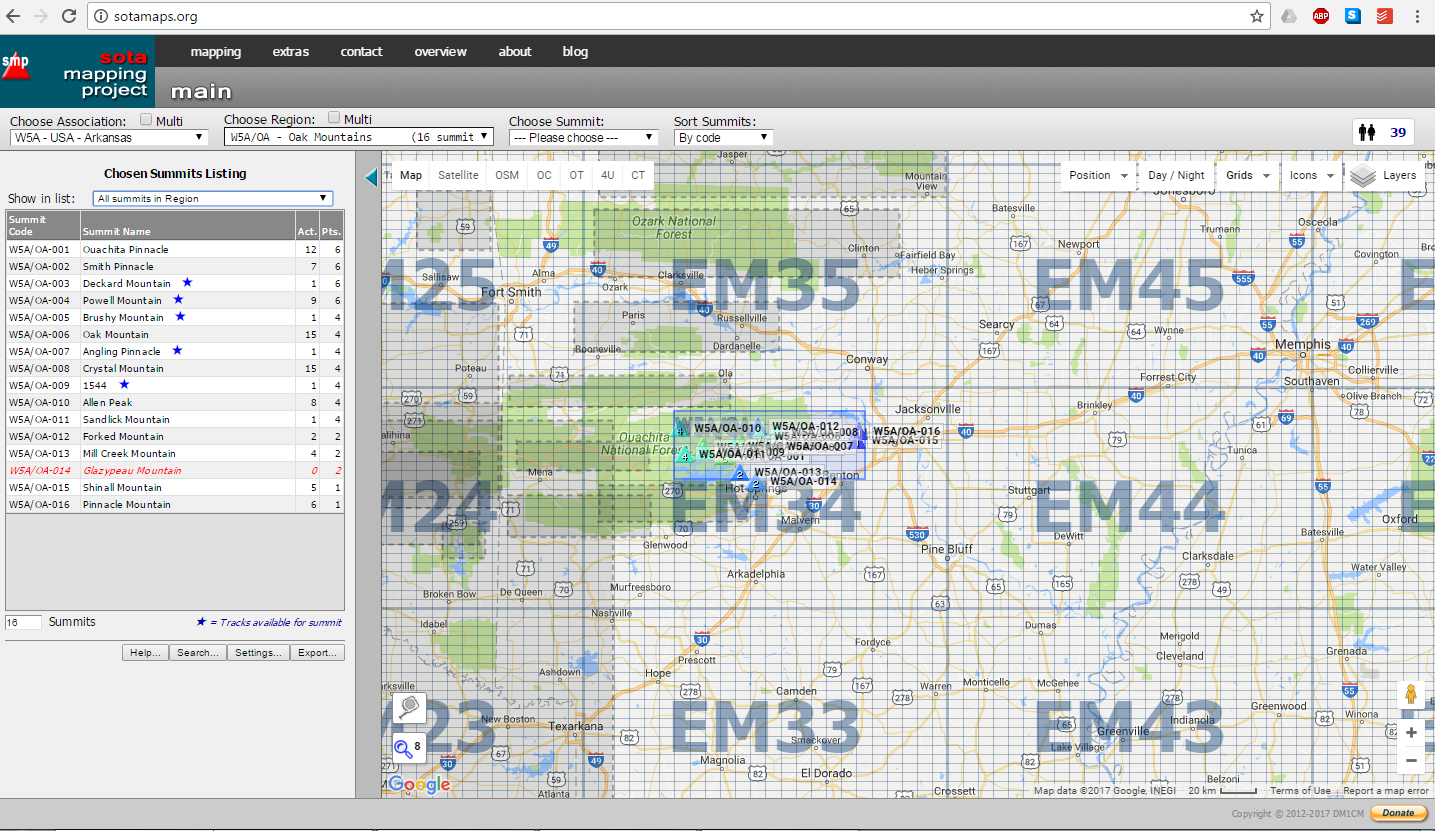
SOTA Mapping Project


A close second to the QTH locator tool is the SOTA Mapping Project - which is alot busier, but also gives a ton more information. While this tool is obviously more tailored for Summits on the Air Activators and Chasers, the grid tools that are over-layed onto Google Maps are fantastic. Plus, if you like going up up mountains, it's pretty much the de-facto information source. 

HamGPS


Once I'm in the field, how do I know where I am? I use an Android App called HamGPS on my phone. It shows me GPS, time, date, lat/long, altitude, and will also display Maidenhead grids If I want them. It's dang useful as well for finding exact grid lines, and grabbing a screen shot of it for evidence later. 

Monday, April 24, 2017

My AMSAT Etiquette - Rule 1


There has been a lot of chatter recently about etiquette, rules, and bad practice on the Satellites. I think it's worth noting how I operate on the birds, not necessarily to tell you it's how it should be done, but more or less to explain my reasoning for doing the things I do. For the record, I still consider myself to be a new operator, even though I'm approaching 3 years active, and have a pile of rare contacts and extreme DXs on my resume. I still look to those who have been active a lot longer than me to temper my attitude.

It's worth noting that there's a big difference between things that are are illegal, things that are bad form, and things that are just annoying. There are also exceptions to basically every rule, that apply in extremely narrow circumstances. I will try to elaborate on these when I can.

So, with all this in mind, I'm going to do begin a new Opinion series on my AMSAT Etiquette rules. Feedback welcome, public or private.


Rule 1: I never transmit at the bird, if I can't first hear it. 

Most satellites in orbit transmit with a PEP of < 1W.. sometimes as low as 250mW. This makes them hard to hear. Even cheap Chinese HTs can transmit up to 5W, and it's very easy to get rigs transmitting 100W or more. This makes you very easy to hear. Satellites are a shared medium, with an uplink and a downlink. You have lots of users that are very easy to hear all trying to access a satellite that is hard to hear. See where I'm going with this? Even if you don't hear the Satellite, it very likely hears you. And while you might be transmitting 'in the blind' I can promise you that someone somewhere else can hear you doing it.... so when I'm thinking about keying up, every though I can't hear anything, I don't. Every satellite active in the sky either has some sort of 'beacon' that announces itself to anyone who can hear it, or has a transponder that has unique noise footprints, or has a carrier tone, or is so stinking busy with other users that it's impossible to miss. It is not a hard thing to wait until I hear the bird, and then key up. It's as simple as that. 

Exception 1: Before claiming this exception one should have a supreme grasp of Situational Awareness (SA). There are times when the bird may be way out over un-populated parts of the world and you might legitimately be the only operator using it. On a bird like SO-50 or AO-85 they have 'wake-up' tones (certain PL frequencies) in order to get the bird working. It is OK to transmit in the blind in order to wake up a bird, that you otherwise know is there, and is approaching your QTH from a part of the world where it's likely not active. This rule can apply to stations operating on the edge of civilization... near the coast, the far north, the far south, that sort of thing. The only time I will do this from Arkansas is if it's the middle of the night, and I *know* the bird should be there, or I'm traveling to an extreme section of the country (Like CM93) and feel pretty good I'm the first human with a footprint. 

Exception 2: When I'm pushing the distance envelope of what the satellite is capable of, and trying to make a contact with someone that I have a mutual window measured in seconds with, I will transmit in the blind for that station, hoping to get the QSO or the tuning started. This also requires Supreme SA, and there should be a very clear start/stop time to this transmission. If I should be hearing myself, and I'm not when the time rolls around, I will stop transmitting. 

Monday, April 17, 2017

The Atomic AMSAT Roadtrip - Part I


On July 16th, 1945 the United States of America detonated the first Atomic weapon in history. The Operation was code named Trinity, and for a brief moment early that morning, the New Mexican sky was lit up by a light that had never before bathed earth. 37 years later on July 16th, 1982 I was born. It doesn't necessarily mean anything, but with my interest in physics and science, it is obviously an auspicious date. I've always wanted to visit the Trinity site, and see things first hand - this year, I had the chance.


As many readers of my blog may know, Gabe, NJ7H, travels the country as what you could call the closest thing to a professional rover this hobby knows, besides people like UT1FG and ND9M. In his short year or so on the birds, he has activated over 250 grids in the US, Canada, and several other countries. Gabe is also a pilot, lives (relatively speaking) close, a few grids away in EM15, and is an all around good guy. Recently during a chat we were talking about Trinity, and I expressed my desire to go there sometime. He said 'well, what about the spring open house in a few months!' - I was sold. I made arrangements with the family, and started planning

The Trinity Site is inside White Sands Missile Range, which is still an active US military installation. It is only open to the public twice a year, once in the spring, and once in the fall. As you would think, places that we test nuclear weapons are not exactly close to civilization, and WSMR fits that bill well. Most of WSMR is in grid DM63 (for us Sat Ops) and it is also deep in what is known as the Chihuahuan Desert, surrounded by mountains in all directions, and at least 2 hours from the closest lodging of any significance. Too add to this, Gabe and I are both active sat rovers, and we had to make a plan to hit as many grids as possible to and from the site. If you know anything about Gabe, you also know that if you're within about 1000 miles of an international border, any roadtrip requires you to cross it. This led do a directive to visit Mexico during the journey too. Also since this was an Atomic roadtrip, we sought out any other landmarks of interest, and found the site of Project Gnome in southeastern New Mexico near the town of Carlsbad, that would be on the way home after visiting El Paso and Juarez. We had a general plan made.


Fast forward a couple weeks, and we were ready to go. I packed up the Mustang and headed for Oklahoma City (5 hours from the QTH) to crash at Gabe's Thursday night so we could get a jump on the trip the next morning. Patrick, AKA 'Jacket Guy' (A non-ham friend of Gabe) also decided to join us on the road trip, and ended up being an awesome addition. We also planned to meet a friend of mine from Arizona, as well as some of Gabe's former classmates from college. All in all, we had a crew. We picked up a rental car (the number of people going dictated something a big larger than the Crosstrek or the Stang) and headed west on I40. We didn't get too far before chatter from the peanut gallery (Other Satellite Ops on Twitter and Hangouts) demanded that we stop in EM05. So hey, why not.


We worked Matt, KK4FEM (who had asked for the stop) and a bunch of others. Now, it's worth mentioning here - that we hadn't really told the rest of the AMSAT community who else was with Gabe and me. I'm the one taking the picture, Gabe is operating, and there is another gentlemen (wearing a jacket) standing by as well. This instantly created the widely trending question of 'WHO IS THE JACKET GUY??' on the Atomic Amsat Roadtrip. Patrick was instantly christened as #JacketGuy.

Continuing down the trail our next goal was to stop on the DM95/DM94 Line, south of I-40 and just east of Amarillo. We had an spot picked out and everything, however due to a sick fascination with airplanes and arguments about what was the best <insert plane here> in the rover vehicle, we totally blasted right past our exit and had to settle for a spot just in DM95. This is when I also remembered my fun discovery of Periscope Live Video via twitter a few weeks back in Wisconsin. I made a few contacts on my station (for rover credit) and then went live:
After our silly Periscoping, we continued west and south. We missed (yet another) exit in Amarillo and had to loop back to head south. Our next stop was a Walmart in DM94, where we grabbed some gas and other provisions. We also went live here while working from the parking lot.
We continued west and South, making one stop in DM84 next to a feed lot that smelled like it. At this point we were hitting grids frequented by Clayton, W5PFG and chaser demand was light, but were racking up credit for our own rover scoreboard. The journey progressed west and south, and afternoon turned into evening. Finally after many miles on the road (and an interesting experience with a crazy homeless guy in Roswell) we hit our first day's destination - The Valley of Fires Campground.


We managed to get our camp setup, and headed back into town for some late evening grub, and made further plans. At this point we were only a few miles from the DM63/DM73 line and figured we should get it activated that night on a nice SO50, AO73, and EO88 trifecta of passes. We drove in the dark until we found the line, and put it on the air. Since this was a set of awfully rare grids, I actually worked NJ7H on AO73, via the my remote station, on my phone, with sketchy reception barely keeping it together for my own chaser credit. After that I setup my own portable station and jumped on the SO-50 pass to join in the rover activation fun. We promptly shut down after those passes, headed back to camp, crawled into our tents, and passed the @#$% out. It had been a very long day, and we had another long day coming up.

Tuesday, April 11, 2017

1 Year & Housekeeping Notes

So my blog has been up for just over a year now, and I've made 21 entries thus far. Some were pretty simple, like saying 'first!1!!', some were just a bunch of pictures, some I probably should have split into multiple entries. With this in mind, I'm going to try my best to stick to the 2 entries per month for the upcoming year, but I might up that if I have a lot of good content. I may also go to a more scheduled approach to things, trying always to get a new blog entry out on Monday, in order to give people something to look forward too.  For note, I've got 6 entries I haven't completed yet, I'm just working on getting content together for them. There's always things I can blog about, it's really just a matter of acquiring pictures and media to have a nice interactive experience :)

Also, after a year of entries I've been able to pretty well classify everything I write into 3 categories. Stories, Tech, and Opinions. I've added Label functionality to my blog, so if you're interested in a particular thing, it's easy to find and pull up - just click on the filter on the right of the page.

I especially will try to keep the Tech category on topic, and editorial free - cause there's a lot of folks interested in that. All my rants I'll definitely keep to Opinion, cause there's only a few interested in that. That's it for now, thanks for reading, and here's to more in the coming year!

Saturday, March 25, 2017

Business Trips, or How I Learned to Stop Worrying and Love Semi-Duplex

2 weeks ago I was told I needed to fly to Milwaukee for  <insert corporate speak here> to do <insert more corporate stuff here>.  My travel plans and work schedule would allow for some downtime to go outside and explore the area, and while there are a few Satellite operators in the area, there were a few grids that needed some rover love too.  Plus it was a part of the country I'd never been to before with the arrow, and I'm always looking to expand my VUCC/R portfolio. A couple things I was thinking about before though.. I've been toying with a home based automated station since the trip to CM93. It's still got a lot of work to go, but it's more or less passable.. kinda... most of the time. Where I was staying for work was only about 90 minutes south of EN65, which is a grid that I (and quite a few others) needed. So how to go operate /P from that grid, with my equipment, and still have equipment at home running my remote station. Also since I would be flying, space would be at a premium and small multi-use equipment would be the order of the day. Also some power (to control the pileups) and all mode capability were a must. What to do..

The Home Station. It mostly Works. 

Well, first thing first - the 821 has to stay at home. Too big, plus it runs the remote station. So that leaves with with the 857 as my only other all mode rig. I've got a Funcube Dongle Pro+ I've used on occasion, but all the stuff to hook up to laptop and run power inverters in the car and a table to put the equipment is such is a pain, and not conducive to a guerrilla portable operation like I was needing to conduct. So after much soul searching (and a couple beers) I settled on the 857 solo. This was not an easy decision to make. In the 3ish years I've been a Satellite operator, I have never run half duplex. Even my very first contact on SO-50 I was full duplex on. I learned that full duplex was the way to be, and the semi-duplexers were lids that just jammed up the birds talking over others. Semi-Duplex operation is the devil and should be shunned. Well, now here I was getting ready to tip toe onto the dark side's playing field. Gee whiz, how things change.

First the build... how to make a mobile rig like the 857 portable. The most obvious solution is to hang it around your neck like the 817, but finding a way to attach it to myself would require some construction. After getting a tip from Matt, KK4FEM, he said that metal rulers ($2 a piece at Harbor freight) make great side mounts for the 857. After grabbing the rulers, finding the correct M6-4 screws, some hole punching and drilling, and liberating and old strap from a backpack, we were in business with the radio. Next I hacked up some small 5 ft RG8X jumpers (cause I've got a ton of that coax laying around) crimped on proper connectors to work with a Comet 4160 Diplexer I had, put my small 8400mah Zippy battery in the pocket of my hoody, connected the mess of cables together and to my spare arrow, and I became a fully contained pedestrian mobile ground station.

Building Tools, out of Tools
So, now to test. From what I understand the standard 'rule' for operating half duplex on FO29 is to find a quiet 10khz chunk of transponder or so AWAY from the center - In this case I went to 435.870 and scanned up and down 10khz to make sure it was clear. I then fixed my TX at 145.930 - figuring I'd come out at 870 +/- doppler. I then took an educated guess (as the bird was about 10° above the horizon) on a 60° TCA pass, figuring I should hear people responding to me about .878 or so. I also made sure to give a fairly long call and specifically say I was half duplex in my CQ call, asking for people to give me a long call in their reply, cause it would take me a second to tune them in. Right away I picked up KD8CAO, who did just what I had requested, giving me a nice long phonetic response allowing me to tune him in easily. We had a quick chat, with my TX remaining fixed on .930 and my doppler slowly dropping in frequency as the bird's relative speed to me changed. I picked up W5PFG and a few more, and called it a successful test. Alright, so this just might work afterall. I packed everything up, loaded up my suitcases, and went on with my week.

Fast forward a couple days and I'm on site in Milwaukee. I find myself on the EN63/53 with my setup. SO-50 is coming, I work the pass, hand out some grids. Not too bad. SO-50 is probably the easiest, and simultaneously the hardest of the birds to work half duplex, in my opinion. In theory you just fix your TX at 145.850, listen on the downlink, everyone is one spot. Piece of cake, right? Well, not so much.. Everyone and their dog is on SO-50 these days, and like any single channel repeater, everyone is talking over each other.. so without full duplex operation, you don't know if you're actually making it in. This is, obviously, problematic.. but it's not the end of the world. If you're in a rare spot, you can let some others do some work for you. Since they're wanting to talk to YOU - they'll keep at it until you answer them. This makes it a bit easier as the one being chased, versus the one doing the chasing. Also, be prepared to answer people a few times if they don't seem to 'hear' you when you respond, there's a good chance you're getting stepped on. Just the way of the world.

It's cold... and dark.. and cold. 
So SO-50 was working pretty well. The next night I tried an AO-85.. this is a little trickier, since you have to adjust the uplink instead of the downlink. Luckily I've worked it enough that I had a pretty good idea of what the doppler should look like, and managed to make a handful of contacts. AO-85 is also a much less busy bird than SO-50 is, and the operators that frequent it tend to have better skill. So, having a handful of passes under my belt, I upped my game a bit.

Peter, 2E0SQL is an AMSAT friend, and at the time was hunting his 100th grid for his VUCC. EN63 (where I was staying) would have been a new one for him. If you notice the callsign though, you know he's in the UK, and transatlantic passes are not exactly a piece of cake, let alone using something other than my 821, and a short arrow, and RG8X, and me being half-duplex. It would be a challenge to say the least, but that doesn't mean we weren't going to give it a shot anyway. So we found a pass that worked, decided on a frequency I would call CQ on, and then he would hunt me down and we'd try to make the contact. Luckily my hotel room was on the 3rd floor, and I had a balcony, and it was facing the proper direction for the bird. So even with alot of factors stacked against us, we had the Location factor on our side. All the stars aligned, and right at my AOS Saturday morning I started calling CQ and Peter found me and we had a very quick QSO at 6200km, with all the above caveats. Not too shabby. Even better, I found MI6GTY calling CQ a few khz below us, and by dumb luck managed to adjust my uplink close enough he was able to find me. So on a 3.2° TCA FO29 pass, with sub-optimal gear managed 2 transatlantic QSOs while still in my pajamas, on the balcony of my hotel room. That was pretty cool, I have to say.

Mountain or Building.. Still all about the Location.

I could keep going on for a while talking about this, but I drove around, made some more contacts, finished up my project, and came home. To tell you the specifics of everything would take multiple more entries, and I don't have that kind of time. I do want to mention specifically though meeting up with David, WN9Q who lives a bit north of where I was doing my work. I had some downtime between passes Saturday afternoon, and I stopped by to meet him for a bit while he was helping at a community Ice Rink. We attempted the world first Zamboni Mobile QSO, but didn't have much luck, being inside a building and all.. We chatted, swapped stories, and played around on the ice with heavy equipment and Arrows... all in all a great afternoon. David is a super cool guy, and it was good to meet him in the frozen north. 73 my friend.

Yes, I was twisting for polarity.

David, WN9Q and Dave, KG5CCI

I guess the point about all this I'm trying to make is, half duplex should not be your go-to method for working the birds. It felt really really weird skipping most of the mode B passes, and not hearing my own voice to know I was getting in and on frequency. I would not recommend anyone use semi-duplex for chasing folks either... unless you're the DX, no one is going to give you the slow calls that are required to switch around and make the QSO. Satellites are a fast and furious business, and you gotta be on the ball to be a good chaser. All this said, if you ARE the DX - and you know people are going to be looking for you, and you're in a situation, like I was, where you're strapped for space, time, and resources, and the only other alternative is simply not having a radio at all... semi-duplex will get the job done. Stick primarily to the mode J birds, fix your transmit, never key up unless you're hearing things first, let the chasers come to you, keeps things simple, and practice. Like every aspect of this hobby, there are lots of ways to get that contact made. Don't let you preconceived notions of how to do things hold you back. Embrace the new and the different. You might just surprise yourself. I know I sure did. 

Illinois State Beach on Lake Michigan. Looks nice, still cold.